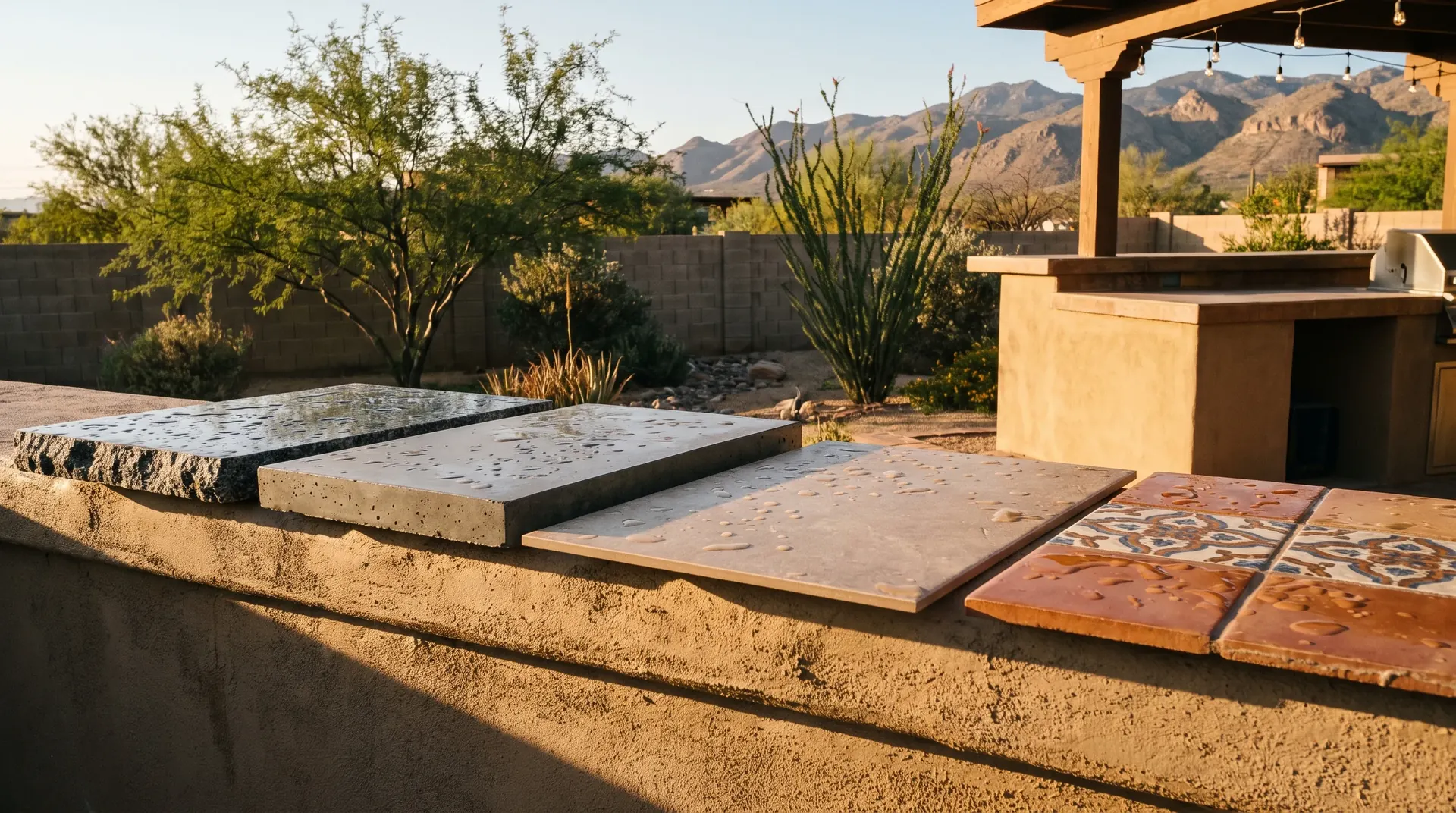
The Best Countertop Materials for a Desert Outdoor Kitchen
For most Tucson outdoor kitchens the answer is granite, porcelain or concrete, in roughly that order of how often we specify them. All three survive direct UV, heat cycling and monsoon rain. The choice between them comes down to how much sun the counter takes, how much maintenance you will realistically do, and whether you want a joint free surface.
The material to avoid is engineered quartz, and that is worth explaining properly because it gets specified here constantly.
Why quartz does not belong outside
Engineered quartz is not stone. It is roughly nine parts crushed quartz to one part polymer resin, and the resin is what holds it together and gives it its colour.
That resin is not UV stable. Under sustained direct sunlight it yellows, and the colour shift is uneven, so a slab that is partly shaded develops a visible line. Beyond the discolouration, the resin and the mineral expand at different rates, and repeated daily heat cycling in a climate like this can cause warping, and in some cases cracking.
This is not a controversial or marginal claim. Effectively every quartz manufacturer explicitly excludes exterior installation from the warranty, for exactly these reasons.
It still gets installed outdoors regularly, usually because the homeowner chose the material for their indoor kitchen and wanted the outdoor counter to match, and the fabricator did not push back. If someone is quoting you quartz for an uncovered outdoor counter in Tucson, ask them for the manufacturer’s written warranty position on exterior use.
What we actually use
Granite
Natural stone, so UV is a non issue. Handles heat, resists scratching, and holds up well to hard water provided it is sealed on a sensible schedule. The most common outdoor counter here and usually the default recommendation.
The one real consideration is colour. Dark granite in direct western sun reaches surface temperatures you genuinely cannot rest a hand on in June. If the counter is uncovered, go lighter than you would indoors.
Large format porcelain
The most technically stable option. Effectively zero porosity, so hard water and staining are minimal, completely UV stable, and available in finishes that convincingly read as stone or concrete.
The trade off is that it is thin and comparatively brittle. It needs a properly prepared substrate and careful edge detailing, and a poorly supported porcelain top will chip at the edges. Done well it is the lowest maintenance surface available.
Poured and precast concrete
Formed to the island, so a long run can be joint free, and it can be cast with an integral drainboard, a curved edge or a seamless backsplash.
It is porous and it needs sealing, and it develops a patina rather than staying uniform. Some people want exactly that and others are surprised by it. Hard water will mark neglected concrete faster than it marks granite.
Tile
The traditional Southwest answer and the reason so many 1980s Tucson islands are tiled. The tile itself is durable and cheap, and the failure point is always the grout, which stains, cracks and needs maintenance.
Still a reasonable budget option on a covered counter with a good epoxy grout. On an uncovered counter that gets heavy use, expect it to look tired.
Stainless steel
Excellent hygienically and completely weatherproof in a marine grade. It also gets extremely hot in direct sun and shows every fingerprint and water spot. Best used for a working section next to a grill rather than for a whole counter.
How to choose for your build
Start with exposure. If the counter is under a deep ramada, the field is wide open and you can choose largely on appearance and budget. If it takes full afternoon sun, the list narrows to lighter granite or porcelain, and colour becomes a functional decision rather than an aesthetic one.
Then be honest about maintenance. Granite and concrete both want sealing periodically. If you know you will not do it, porcelain removes the question.
Then consider joints. A long run in slab material will have a joint somewhere. Poured concrete avoids that entirely, which is why it comes up on large islands.
Finally, whatever you choose, insist it is set with a slight fall so water runs off. A dead level counter holds water against the appliance cut outs after a monsoon, and that is where corrosion starts.
Getting it specified properly
We template off the finished island rather than the drawing, and we set the fall in as standard. If you already have a fabricator you like, we are happy to work with them, and we will still tell you if the material being proposed is wrong for the exposure.
More detail on outdoor kitchen countertops.
Answers
Countertop questions people ask
What is the best material for an outdoor kitchen countertop?
Granite for most builds, porcelain for the lowest maintenance and best UV stability, concrete if you want a joint free surface formed to the island.
Is granite or quartz better for outdoor kitchens?
Granite, clearly. Granite is natural stone and is unaffected by UV. Quartz is bound with a polymer resin that degrades in sunlight, and manufacturers exclude outdoor use from warranty.
Why can't quartz be used outside?
The resin binder is not UV stable. It yellows unevenly under sun, and differential thermal expansion between the resin and the mineral can warp or crack the slab.
What is the cheapest countertop for an outdoor kitchen?
Tile over a properly built substrate. Durable and inexpensive, with grout maintenance as the ongoing trade off.
What type of countertop is best for an outdoor bar?
Something you can comfortably rest your arms on, which in practice means lighter coloured granite or porcelain. Dark surfaces on a bar in western sun become unusable in summer.
What is the best surface for an outdoor kitchen?
For an uncovered counter taking real sun, a lighter granite or a large format porcelain. Under cover, almost anything on the list above works.
What can I use for an outdoor kitchen countertop?
Granite, porcelain, concrete, tile or marine grade stainless. Avoid quartz, laminate, butcher block and any engineered surface with a resin binder.
Free quote
Not sure what to specify?
Tell us how much sun the counter will take and we will give you a straight recommendation.
- We call you back, usually the same working day.
- We come out and measure before anyone quotes a number.
- The quote is itemised, with the appliance allowance shown separately.
- No sales visit until you ask for one.
Keep reading
Other guides worth your time
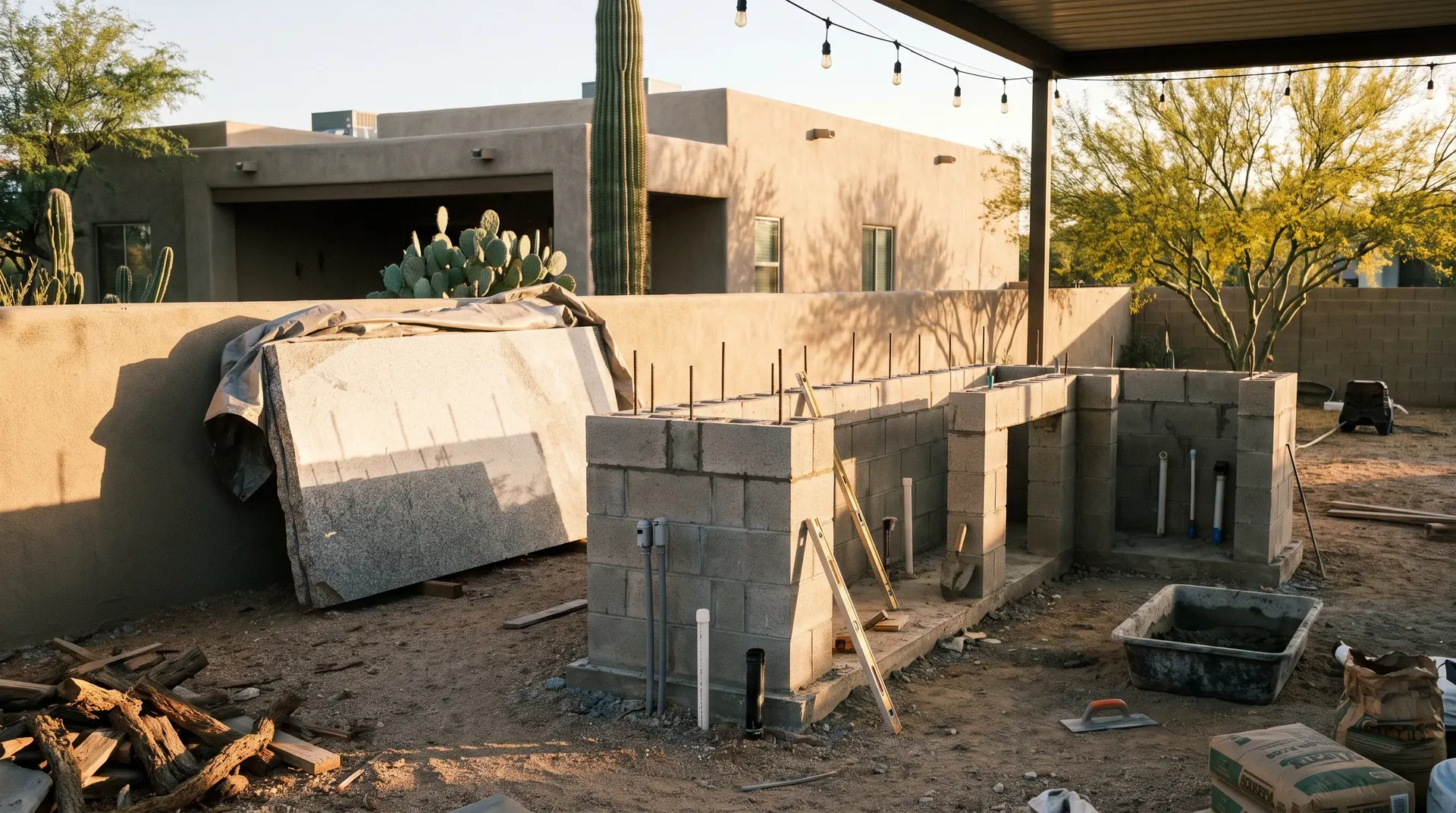
How Much Does an Outdoor Kitchen Cost in Tucson?
Real ranges by tier, what pushes the number up, and where people waste money.
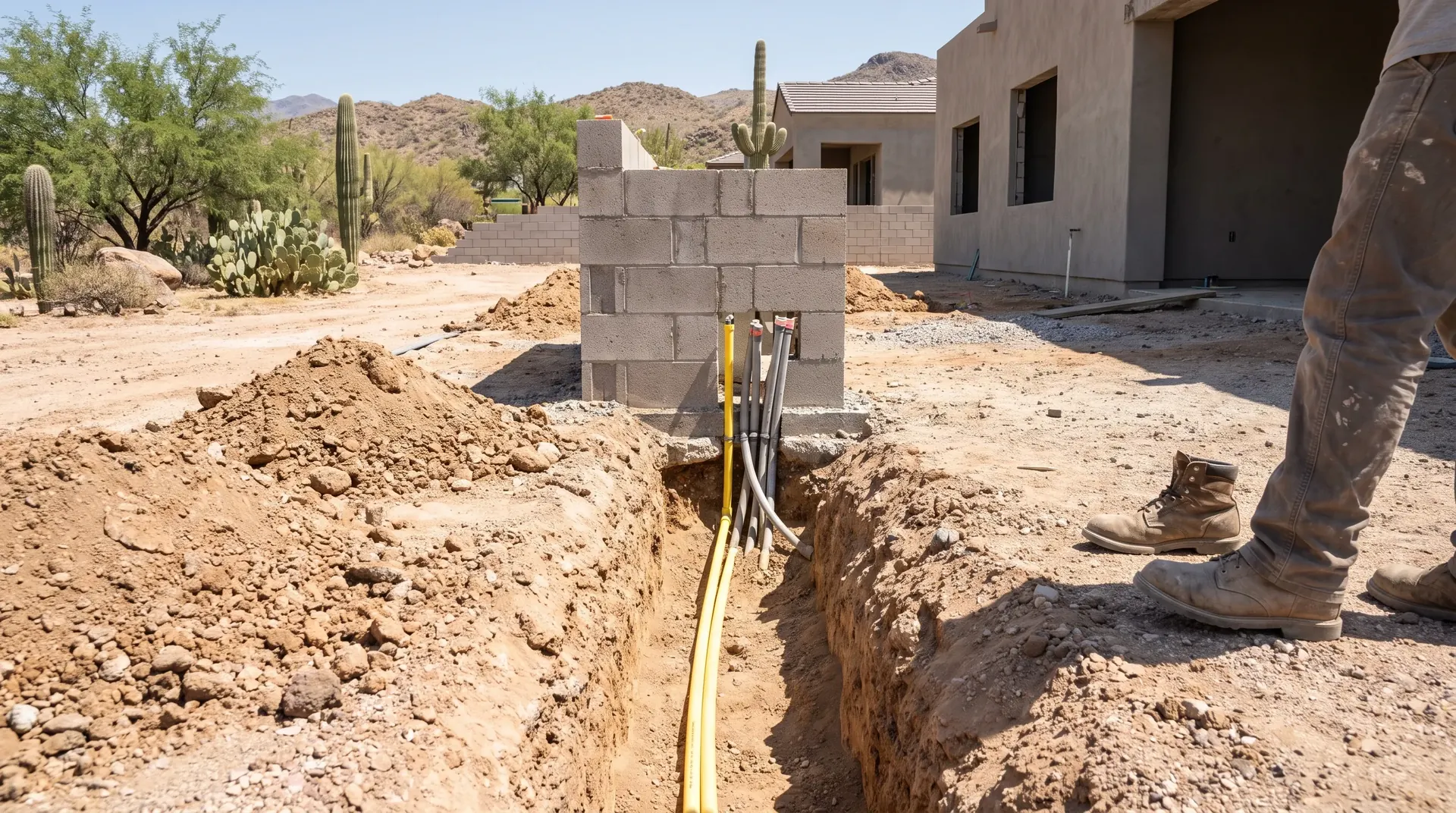
Outdoor Kitchen Permits in Tucson and Pima County
When you need one, which office you deal with, and what happens if you skip it.
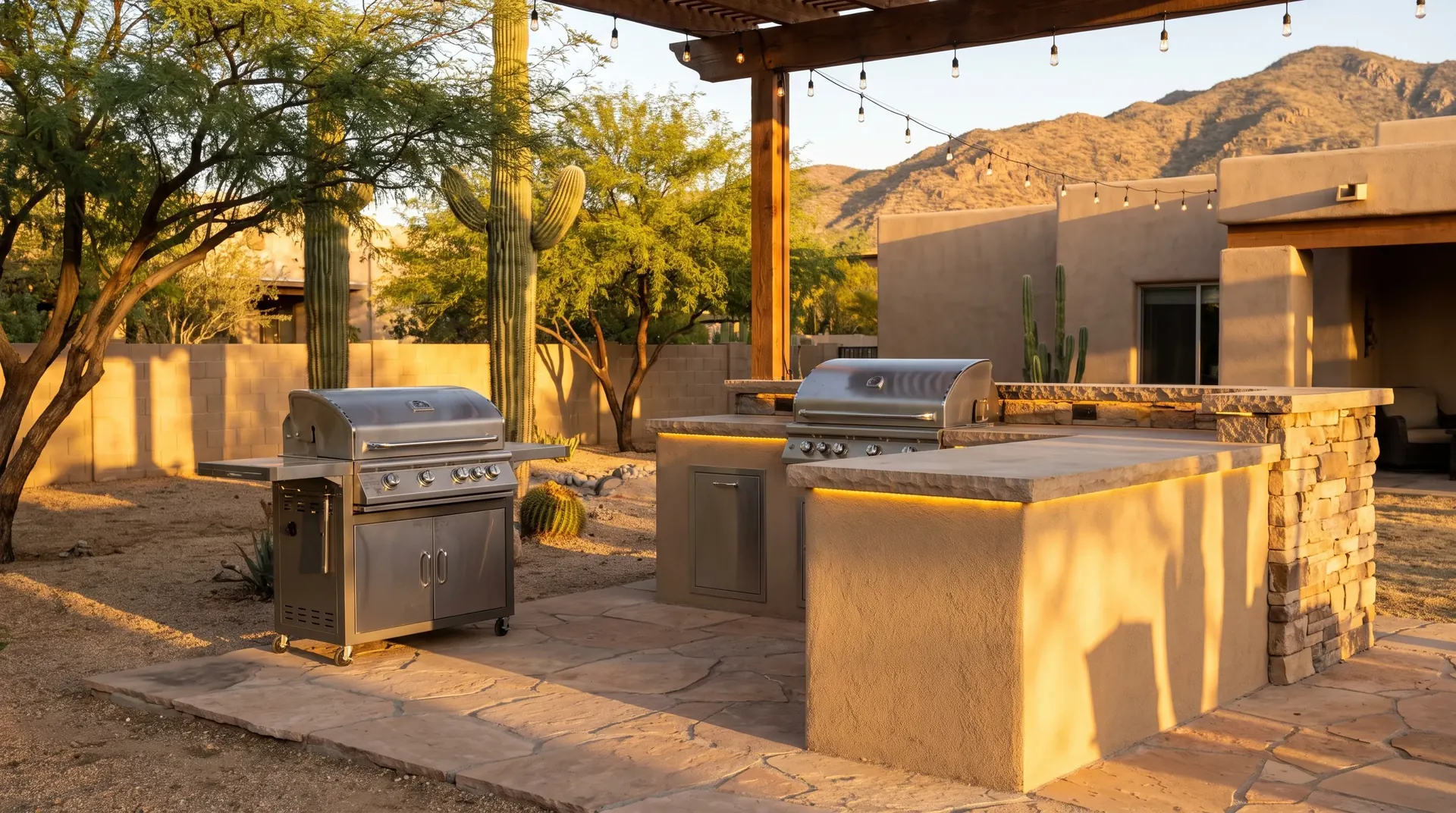
Is It Cheaper to Build or Buy an Outdoor Kitchen?
Prefab, modular and built in place compared on cost, lifespan and resale.