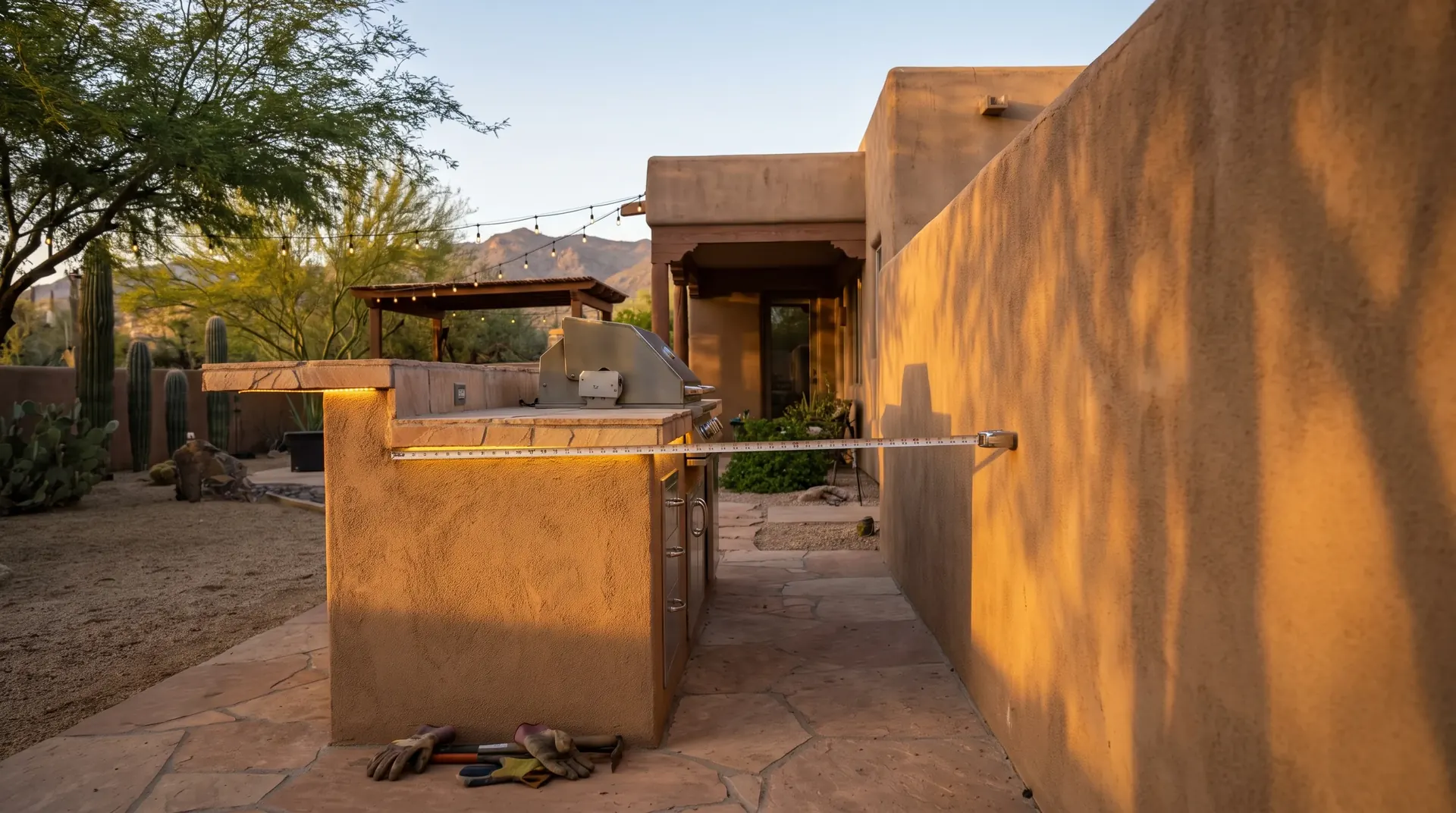
How Far Should an Outdoor Kitchen Be From the House?
There is no single number, because two separate rules apply and they are set by different people.
The first is the appliance clearance, set by the manufacturer of your specific grill or oven. It is about heat and combustion, and it is a safety requirement rather than a suggestion. The second is the setback, set by your jurisdiction, and it is about property lines and structures.
You have to satisfy both, and they are rarely the same distance. A grill that meets its manufacturer clearance can still sit somewhere a setback does not allow.
Appliance clearances come from the manufacturer
Every built-in grill has a specified minimum clearance to combustible material, in every direction, and for built-in installations it is usually larger than for the same grill freestanding. The surround traps heat that would otherwise dissipate.
The numbers vary meaningfully between manufacturers and models, so the only correct source is the installation manual for the exact appliance going in. A general figure repeated online is not a substitute.
Three things people get wrong:
Clearance to the wall is not the only one that matters. Clearance above, to an eave, a soffit or a cover, is frequently the binding constraint and is the one most often overlooked.
Stucco over frame is not automatically non combustible. What is behind it matters.
The clearance applies to the appliance, not the island. Setting the island back far enough does not help if the grill sits at the back edge of it.
Verify and insert: a typical clearance range should only be published with a manufacturer and model cited, or stated as a range with a clear instruction to check the specific manual. No hard number goes here until then.
The practical distance, beyond the minimum
Meeting the minimum clearance stops the wall catching fire. It does not stop the wall getting dirty.
Grill smoke rises and tracks along whatever is above it. A grill close to a house wall under an eave will stain the wall and the underside of the eave, and on a light stucco that shows within a season. Under a covered patio the same thing happens to the ceiling.
Grease is the other half of it. Anything within a few feet of a grill collects an airborne film that is genuinely difficult to remove from textured stucco.
So the practical distance is usually further than the code minimum, and where the grill has to be close to the house, the answer is either a vent hood or accepting that the surface above will need cleaning and eventually repainting.
Setbacks are a separate question
Setbacks govern how close a structure can be to a property line, and sometimes to the house itself. They vary by jurisdiction and by zoning, and in this metro that means the answer differs between the City of Tucson, unincorporated Pima County, Oro Valley, Marana and Sahuarita.
A permanent island is more likely to count as a structure than a rolling grill is, and adding a roof over it makes it a structure almost everywhere.
Verify and insert: current setback requirements per jurisdiction. See the note on the permit guide. No setback figure from a national source goes on this page.
Getting the position right
We check both constraints at the site visit: the manufacturer’s clearance for the appliance you have chosen, and the setback for your parcel. The position gets marked on the ground before anything is agreed.
If you want the kitchen against the house because that is where the utilities are, say so. It is often workable. What it needs is the wall construction checked, the eave clearance confirmed, and a conversation about smoke staining before rather than after.
See outdoor kitchen installation and the permit guide.
Answers
Clearance questions people ask
How far should an outdoor kitchen be from the house?
Far enough to meet the appliance manufacturer's clearance and your jurisdiction's setback, whichever is greater, and usually further again if you want to avoid smoke staining the wall.
Can I put an outdoor kitchen against my house?
Frequently yes, and it is often the cheapest position. It depends on the appliance clearance, what the wall and eave are made of, and whether you accept some smoke staining above the grill.
How far should a built-in grill be from the house?
Built-in clearances are typically larger than freestanding ones for the same grill, because the surround retains heat. Use the installation manual for that specific model.
Do you need a permit for an outdoor grill?
Not for the grill itself. The gas line to it is usually what requires the permit.
What is the largest structure I can build without a permit?
That threshold varies by jurisdiction and it is one of the specifics to confirm with your local office rather than take from a national article. Adding utilities or a roof often removes the exemption regardless of size.
Free quote
Not sure where it can go?
Send us a photo of the space and the grill you have in mind. We will check the clearances and the setback for your parcel.
- We call you back, usually the same working day.
- We come out and measure before anyone quotes a number.
- The quote is itemised, with the appliance allowance shown separately.
- No sales visit until you ask for one.
Keep reading
Other guides worth your time
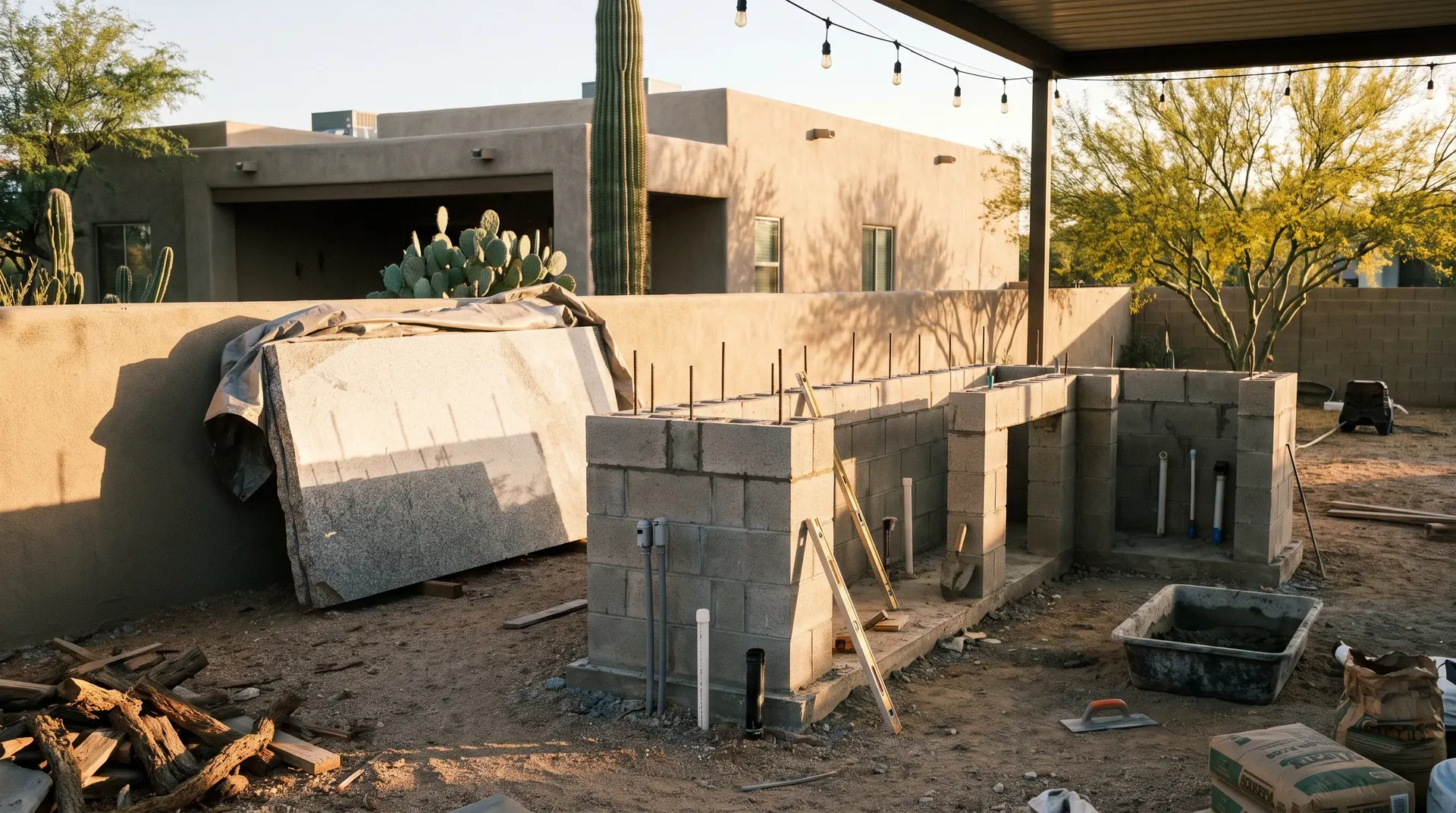
How Much Does an Outdoor Kitchen Cost in Tucson?
Real ranges by tier, what pushes the number up, and where people waste money.
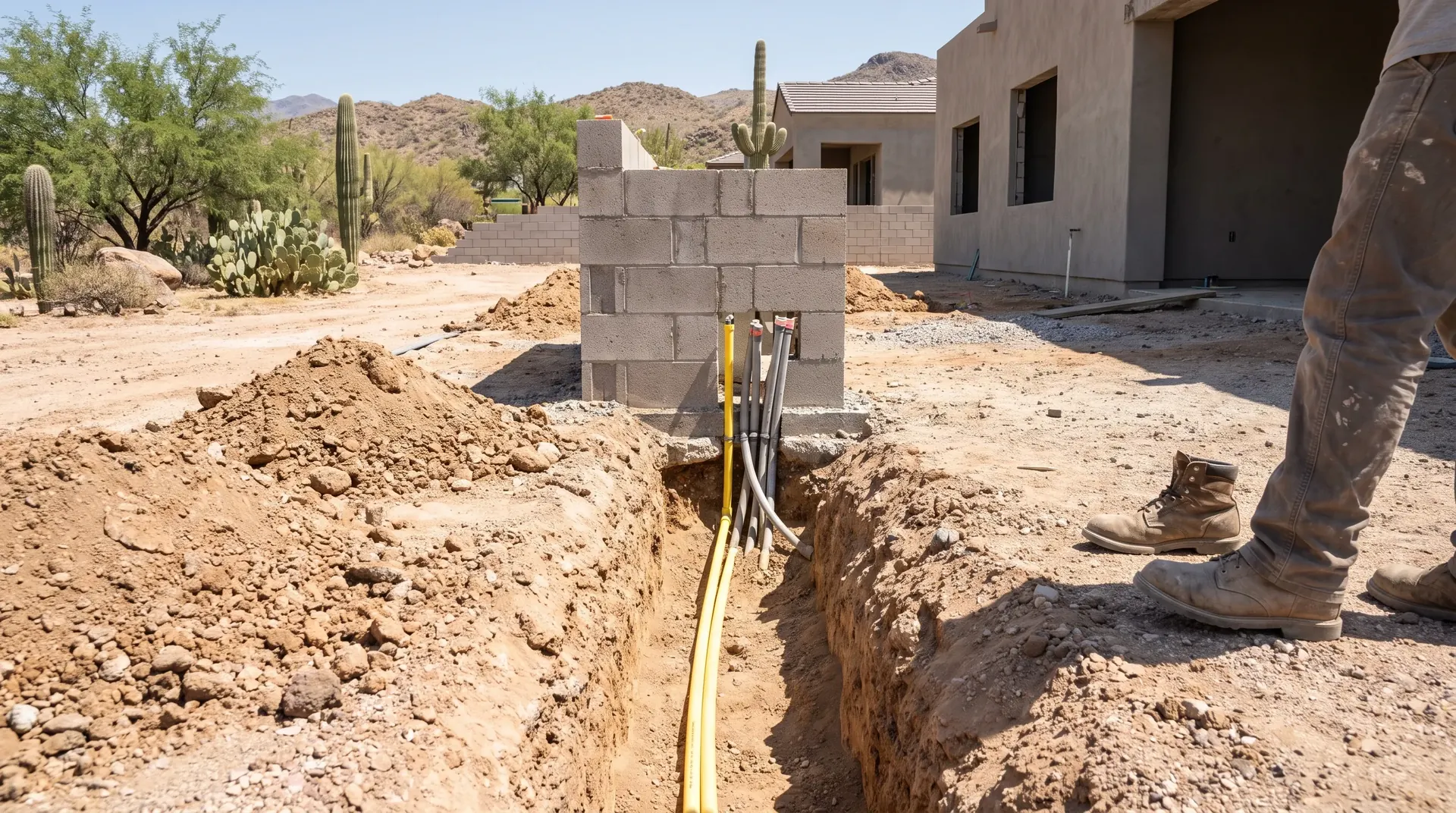
Outdoor Kitchen Permits in Tucson and Pima County
When you need one, which office you deal with, and what happens if you skip it.
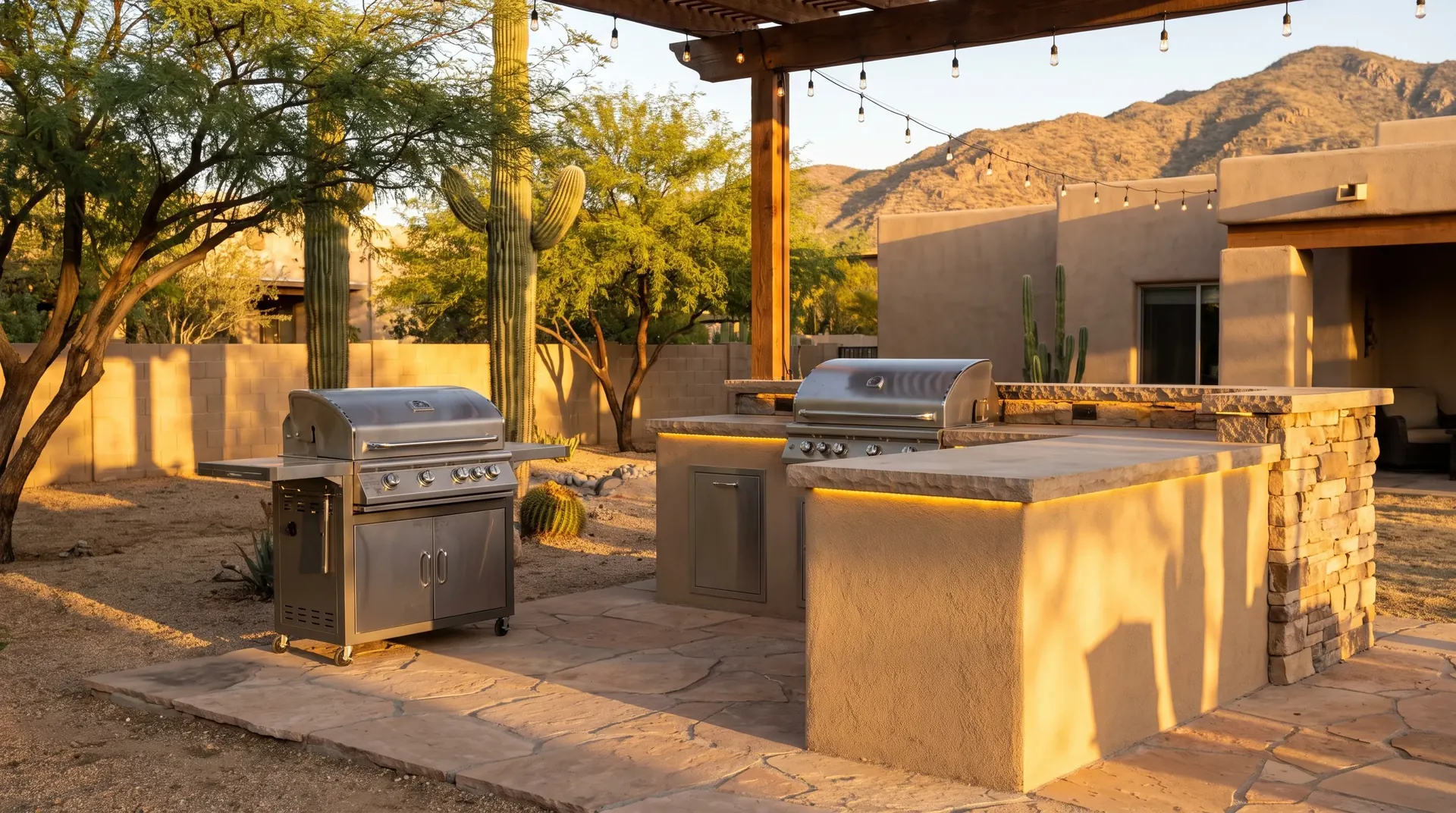
Is It Cheaper to Build or Buy an Outdoor Kitchen?
Prefab, modular and built in place compared on cost, lifespan and resale.